

Main Page
AOWIS – Afritic Open Standard for Water & Agricultural Infrastructure
AOWIS is an open technical standard for safe and reliable water and agricultural infrastructure, designed for low-resource environments.
It defines how systems are operated through sensors and actuators, either autonomously, manually, or in combination. AOWIS is designed to function under conditions such as unstable power, limited connectivity, and minimal technical support, supporting both online and offline operation.
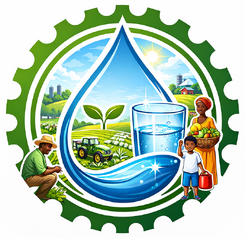
In less developed regions, such as rural areas and small towns in Africa, water distribution remains a significant challenge. While NGOs have been successfully supporting communities for decades by drilling wells, installing pumps, and sometimes building water towers, distributing water across a network on the surface is often difficult.
Local initiatives that take on these projects frequently encounter a situation where operating the system manually becomes unsustainable, requiring constant attention. Qualified personnel are scarce, and suitable technology to support automated or semi-automated operation is either unavailable under local constraints or too expensive.
This is where AOWIS aims to contribute: by providing an open standard for designing, deploying, and managing water and agricultural infrastructure in such environments. AOWIS supports both the planning phase—helping initiatives evaluate and design systems based on regional conditions such as topography—and the operational phase, including system monitoring, control, and maintenance.
In addition, AOWIS aims to support the training of local technicians and to collaborate closely with experienced NGOs and local initiatives that already operate and maintain such systems, in order to improve sustainability and reduce operational burden.
AOWIS is designed to operate under the real-world conditions faced by local initiatives. These include, among others:
- unreliable power supply
- intermittent connectivity
- diverse or aging equipment
- limited availability of trained personnel
- the need for safety and autonomous operation
AOWIS enables systems that continue to function safely and reliably, even under degraded or adverse conditions.
AOWIS addresses these operational challenges through the following principles:
- human-in-the-loop control
- offline-first operation
- safe fallback behavior
- modular and extensible logic
- shared infrastructure models
- transparent governance
The goal is to make essential systems robust, maintainable, and locally operable.
AOWIS is built around a three‑layer control model:
- Field Controller – Local, autonomous, safety‑critical
- Farm Controller – Coordination, scheduling, logic
- HQ Controller – Oversight, reporting, governance
Core principles include:
- Offline‑first
- Measurement‑driven
- Fail‑safe by design
- Human‑operable at all times
- Modular and extensible
- Transparent and auditable
If you are new to AOWIS, begin with:
- Design Philosophy
- Definitions
- Normative Requirements
- Module Template
- Contributor Guide
- Writing Style Guide
These pages explain how to read, use, and contribute to the standard.
The AOWIS standard is organized into dedicated namespaces. These sections form the technical backbone of the project.
- Standard – Normative requirements and definitions
- Concepts – Philosophy, rationale, and real-world context
- Architecture – System structure and controller design
- Infrastructure – Physical systems and components
- Measurement – Sensors, manual readings, derived values
- Data – Data models, logs, sync formats
- Operations – Runtime logic and decision hierarchy
- Modules – Domain-specific extensions
- Reference – Concrete examples, reference implementations, sample systems
- Databases – Federated knowledge bases
- Governance – Certification, compliance, licensing
- Training – Human capacity building
For a full overview, see the Table of Contents.
AOWIS includes a transparent governance model to ensure:
- open participation
- clear certification processes
- stable versioning
- long‑term protection of the standard
See: Governance.
At this stage AOWIS is in early development and conceptualization phase. The next steps for the technical development are:
- Developing sensors to measure water level in reservoires.
- Developing sensors to measure voltage to protect devices from overvoltage and to calculate solar battery capacities.
* Find ways how to shut down from electricity supply in case of overvoltage.
AOWIS is an open, evolving standard. Contributions are welcome.